Bang All the Keys at Once and the Behavior Still Comes Out — Huberman on the Neurotech Frontier
Invest Like the Best EP.494: Andrew Huberman on reading and writing to the nervous system, the three prerequisites for sleep, and a memory model punctured by its own control experiment. Listening notes, educational only, no investment advice or stock recommendations.
Contents
One should live in accord with yin and yang, in measure with number and method, eating with restraint and rising with regularity, never driving the body past its work — then form and spirit hold together. —— Huangdi Neijing, Suwen, “On the Innocence of High Antiquity” (compiled before the Western Han; translated by the author)
On October 6, 2026, in episode 494 of Invest Like the Best, host Patrick O’Shaughnessy asked Stanford neuroscientist Andrew Huberman what the biggest problem in his field is. His answer: writing signals back into the waking nervous system — and his prediction is that Meta, OpenAI, Anthropic and Neuralink all end up as biotech companies. He mentions an eye mask that shortens time-to-sleep and measures REM directly, seven to twelve months from release, and gives his own sleep ledger: seven hours is best, six is manageable, two consecutive nights under four and he is cratered. Every one of these claims rests on one premise — that non-invasive stimulation can achieve spatial and temporal selectivity — and that step has not been taken yet.

I Thought the Hard Part Was Placing the Electrode
Before listening, my model was simple: neurotech is stuck on hardware. Make the electrode finer, the placement more accurate, ideally skip opening the skull, and the field moves. So I filed it under engineering problems far from my life, and expected the episode to be a supplement list.
The conversation went somewhere else. Huberman lays out the tools we already have and names the defect they share. Caffeine lowers the threshold at which neurons fire; sedatives raise it; Adderall and modafinil raise the RPM of the whole brain, which is why you get the shaking and the mind that won’t shut off. SSRIs raise serotonin and with it plasticity; psilocybin does the same thing much harder, unmasking lateral connections so you form new associations in a compressed window. And he is blunt about the price: those receptors sit all over the brain, so you get the sexual side effects and the weight changes along with the benefit.
The weight falls on “all over.” The tools are blunt because of receptor distribution, not because the dose is untuned. He notes transcranial magnetic stimulation is already used to treat depression and its spatial control is “not great.” The real problem is how to light up one brain area alone, quiet one area alone, and dial the quieting deeper or shallower — the nervous system runs on graded signals, thresholds move, even drive and motivation come with a scale on them. His bet on what gets there is ultrasound.

That is where I moved the file. This isn’t waiting for hardware to get finer; it has to answer a prior question — which population of neurons are you trying to talk to.
Bang All the Keys at Once and the Behavior Still Comes Out
The next stretch is the part that made me sit up, and Huberman says his colleagues would rather not discuss it.
Labs including Mark Mayford’s and Susumu Tonegawa’s run an experiment like this: an animal learns something — a maze, a lever press that pays out — while they record the firing pattern of the neurons involved, then tag those neurons with a chemical marker. Come back later, reactivate them in the same sequence, and the animal performs the behavior. So far the textbook holds: A leads to B leads to C, and the order produces the act, like playing a phrase from the score.
Then they ran the control. Reactivate the same neurons in the opposite order. Or activate all of them at once. Huberman’s image: take every key that phrase uses and bang them simultaneously — the piano makes a sound nothing like the song. And the result? You get the exact same behavior.

Here is why that stings. The visual pathway’s directionality is settled: eye to thalamus up to cortex, and cut it at the thalamus and perception is gone, confirmed in human patients. Memory, thinking and plasticity are modeled on that same assumption about temporal order, and the control experiment says it probably fails for memory. For anyone trying to write to the nervous system, half of this is good news: forget the sequence, just wake the set up. The bad news is the sentence he adds next — those same neurons are also doing some piece of your recall of childhood, and other perceptions, and other movements. The nervous system repurposes one population into different circuits depending on what you are perceiving and doing. So however well you aim, the thing you hit is shared.

His friend Eddie Chang, chair of neurosurgery at UCSF, takes the detour instead. To get a locked-in patient speaking, he doesn’t record from speech production; he spent decades characterizing the signals leaving the speech planning areas, then converts those into computer speech — because the signals can’t reach the pharynx and larynx, and speech is the pharynx and larynx shaping an exhale. The model has a hole in it, and he walks around the hole.
Now I Ask Which Waking State I’m In
So where does this leave me. The problem Huberman most wants solved is a definition of waking states, and that line stayed with me. For sleep we have N1, N2, N3 and REM — and he points out that REM names the fact that the eyes are moving, not how it feels to be in it. Right now, recording, awake, focused, enjoying the conversation: what is that state called? It has no name. Without a name you can’t measure it, and without measurement there is nothing to write.
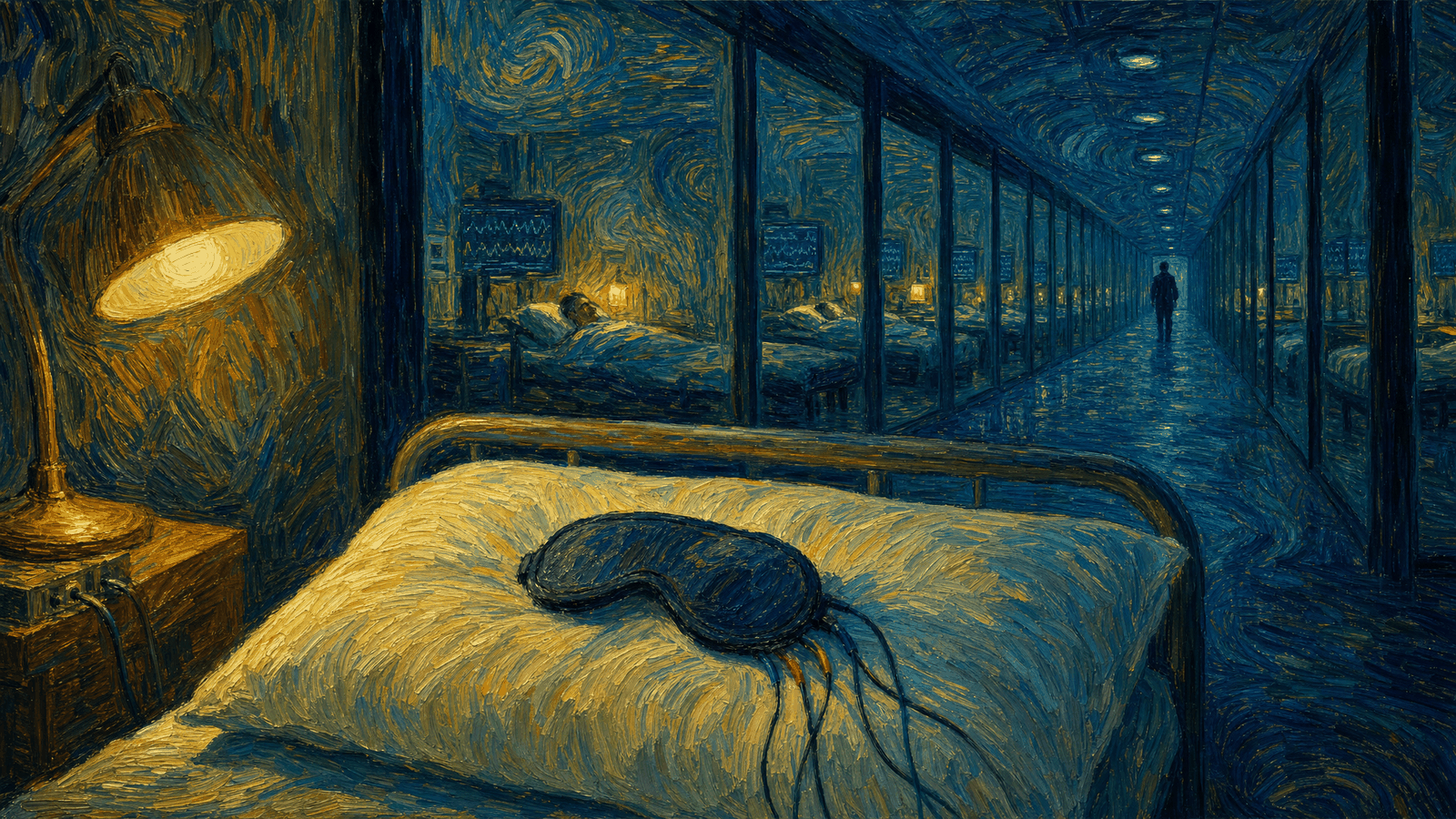
I suspect readers have a matching complaint; I do. After the close my head won’t come down, the next morning I’m flat, and I file that under insufficient discipline. Patrick confesses on air that downshifting takes him four hours — from a wired, exciting day to being able to sleep — and hearing that was a relief. Huberman’s answer is three prerequisites, and missing any one keeps you awake: turn the thoughts off, bring the heart rate down, forget where your limbs are in space. The first runs opposite to meditation — meditation asks you to hold attention in one place, he asks you to migrate it to your feet, your breathing, the sounds in the room, and back, moving out of thinking and planning into pure sensation. The second runs on long exhales: on the exhale the heart’s volume drops and the brain sends the slow-down signal through the vagus, so empty the lungs and let the inhale happen on its own. The third is the fun one — rocking puts babies and adults to sleep, and what does the work is the compensatory eye movement happening under closed lids. A group at MIT handed him a mask that drives those slow back-and-forth movements with a little stimulation behind the ears, and he says it works for him day or night.
What I care about most is a different thread. Melis Yilmaz, a former postdoc of his, built a cuff that reads autonomic activity directly and then tells you, at day’s end, which activities put you in distress and which in eustress. Huberman relays her finding: the high-arousal state you enter doing something you love may set you up for better sleep and better focus. Compare that to current wearables, which capture heart rate and HRV and then interpret stress and recovery for you — an inference. I have paid for this mistake in investing: treat a proxy as the truth, then make decisions against the proxy, measuring diligently the whole time and measuring the wrong thing. So I didn’t buy a device. I spent a week writing down the moments I couldn’t come down, and what I was doing at the time.
The uncertainty I’ll quote from him directly. He says he was born and raised in Palo Alto with friends in tech and medicine, and that people have been telling him lately he isn’t scared enough of AI. He tried the mask and holds no stake in it; the seven-to-twelve-month timeline is the company’s. On the He Jiankui story he says three separate times that he doesn’t know whether it’s true. And his verdict on public health discourse — the bar for entry is zero, show your abs and you have a following, and “it’s very easy to get attention, it’s very hard to keep respect.” I use that as a filter on who to read: does this person say out loud where they’re unsure.
Worth a Look
- Invest Like the Best EP.494, October 6, 2026, Patrick O’Shaughnessy with Andrew Huberman
- Huberman’s book Protocols, which he calls his thesis on the health material — turned in, so he can move to neurotech
- People named in the episode: Eddie Chang (UCSF neurosurgery), Karl Deisseroth (the clinical vagal-stimulation account), Melis Yilmaz (the autonomic cuff), Matt MacDougall (head of neurosurgery at Neuralink), Barbara Chapman (his graduate advisor)
- Terms to look up yourself: respiratory sinus arrhythmia, proprioception, transcranial magnetic stimulation, adeno-associated viral vector
One Thing Worth Taking With You
One idea: a proxy used long enough gets mistaken for the thing itself. HRV is not stress, it is the shadow of stress; REM names moving eyes, not how the state feels. You end up managing whatever you measure, so the cost of measuring the wrong variable is that your effort goes to the shadow while you feel well-instrumented the entire time.

Something I’ve tried, and it starts tonight: take three minutes before bed and write down the moment today your head wouldn’t come down, and the thing you were doing then — the event, not a feeling word. “Got off the call with the client,” “the post-close reconciliation wouldn’t tie,” “talked with my daughter about changing majors” all count; “stressed” doesn’t. Keep it seven days, then look at the list and count how many of those things you actually like doing.
This article is an educational discussion of investment method. It is not advice to buy or sell any individual security, offers no target prices, and does not analyze any current holding. Investing carries risk; make your own decisions or consult a qualified professional.
Comments
Loading comments…