The Last Order of Brazil's Armored Vehicle King
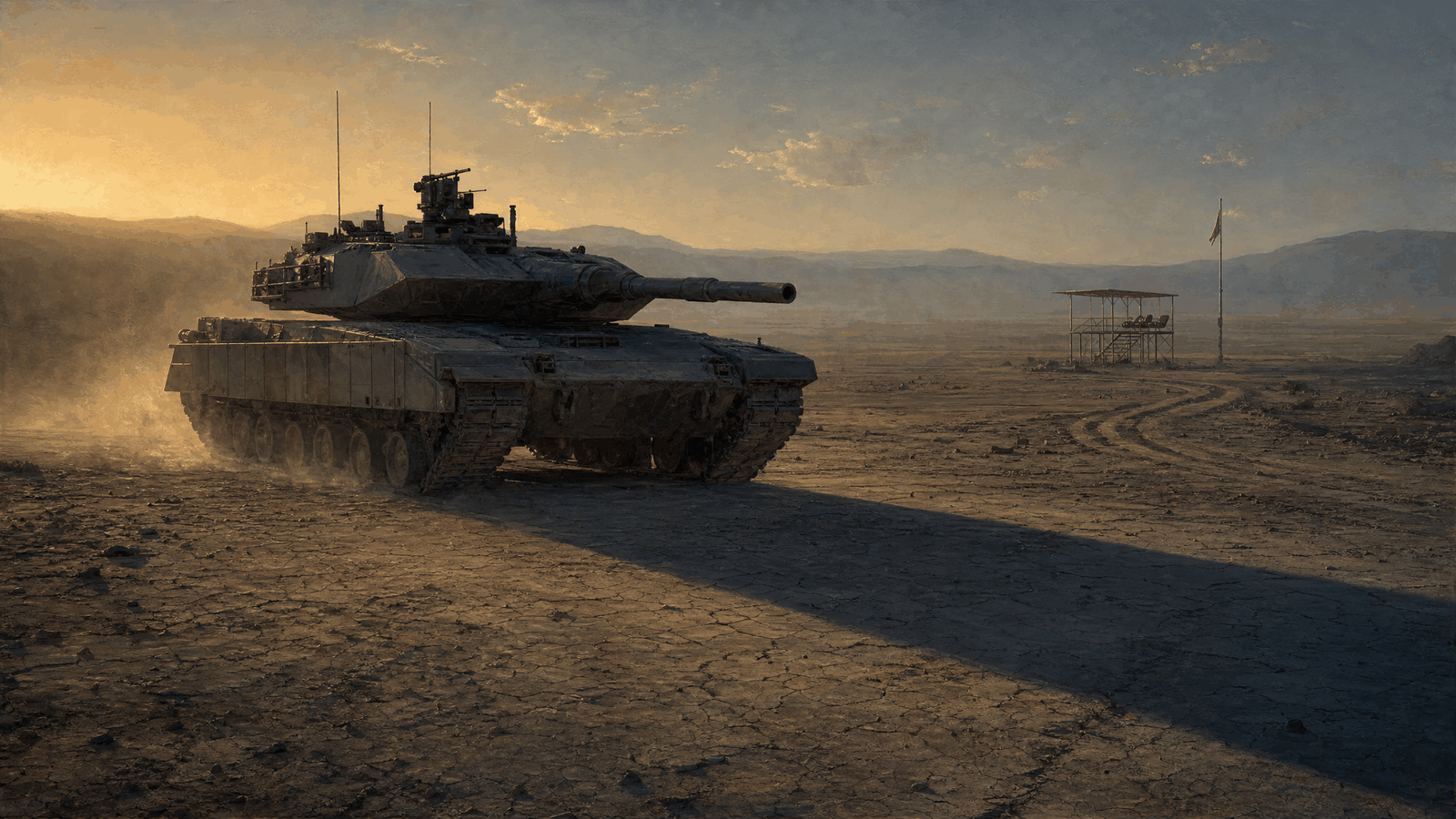
Notes on Asianometry's 4 October 2026 episode about the collapse of Brazilian arms maker Engesa — customer concentration, patron risk, and how leverage multiplies both. Educational, not investment advice; no stock recommendations or price targets.
Contents
- A small engineering shop in the business of bad roads
- Vehicles named after vipers, sold to Libya
- The Iraqis threatened to send it all back
- He decided to build a tank
- The second round of Saudi trials
- Then peace arrived
- The day after the inauguration
- When a big order turns into a hostage
- How to price a patron
- Sources worth reading
- The One Thing to Take With You
Survey the worthies of old, their states and their houses: built by thrift, broken by excess.
—— Li Shangyin, “On History, Second of Two” (Tang, c. 9th century; translation mine)
Asianometry’s 4 October 2026 episode, “The Fall of Brazil’s Armored Vehicle King,” traces how the Brazilian armored vehicle maker Engesa went from being one of the developing world’s largest arms exporters to bankruptcy. The episode notes that Iraq bought over a billion dollars of Brazilian military equipment between 1980 and 1987 — about a third of the country’s entire arms exports — and that through the 1980s Engesa carried debt equal to 100% of its equity, against roughly 40% for the average Brazilian firm. It staked its survival on a $2.2 billion Saudi tank deal; Brazilian press announced in August 1989 that signing was ten weeks away, and in September US outlets reported Saudi Arabia buying 315 M1A2 tanks from General Dynamics for $3.1 billion. Two conditions frame the ending: its orders were concentrated in one war, and its patron was a military government about to hand over power.
A small engineering shop in the business of bad roads
In 1958 a mechanical engineer named José Luiz Whitaker Ribeiro started Engesa with eight employees; the name means “specialized engineers.” They made oil pumps and parts for transport vehicles, and their main customer was a local refinery reached by terrible roads.
Their answer was a custom 4x4 traction system that let the two sides of the vehicle move independently, so at least two wheels stayed on the ground whatever the terrain did. It was heavy and it was expensive, and in Brazil’s rough backcountry it kept moving. Later it became their proprietary Boomerang system. The state oil company saw it and began borrowing their trucks; a Brazilian army officer saw it and thought it could rescue the army’s World War II-era fleet. In 1968 Engesa signed its first military contract, fitting its suspension to about 100 GMC trucks.

The timing of that small contract was extraordinary. The United States, bogged down in Vietnam, was dialing back sophisticated arms exports to the developing world. Brazil turned to Europe, bought half a billion dollars of weapons on unfavorable terms, and from the late 1960s the government began building a domestic arms industry — Embraer and the rocket maker Avibras both took shape in those years. In 1971 the Brazilian army handed Engesa the IP for its own armored vehicle designs to mass-produce. Half the reason was technical competence; the other half was Ribeiro’s nationalist reputation and his personal relationship with the army’s design group.
Vehicles named after vipers, sold to Libya
Ribeiro personally oversaw how the steel plates sat on the chassis, and presented two vehicles: the six-wheeled EE-9 Cascavel with a gun on top, and the EE-11 Urutu, an amphibious carrier for fourteen soldiers. Both names are venomous snakes; in those years the company liked naming its vehicles after dangerous ones, and a later tank destroyer was called the Sucuri, an anaconda.
The problem arrived quickly: domestic demand could not fill the factory they had already built. The navy and army bought some, future orders were not guaranteed, so they went abroad. When the 1973 oil crisis hit, Brazil — a major oil importer — struggled to find the foreign currency it needed, so Engesa pivoted toward customers who could pay in oil. Their Portuguese distributor supplied the angle: newly independent countries in Africa and the Middle East would rather buy from a fellow former colony than from their former colonizers. When the Carter administration tied arms sales to human rights records, a set of rejected buyers became Engesa customers.
The reason these vehicles sold is plain. One civilian who drove one called it “ugly, but efficient,” and simple enough that “even a dummy private can operate them.” Libya preferred the bigger gun on the competing French car, so Engesa enlarged the vehicle to take that gun, swapped in a different engine, and talked a French arms firm into supplying it; when the French supplier noticed it had competition and raised prices, Engesa licensed a similar design from a Belgian firm and built it at home. Customization became the selling point, down to integrating Soviet equipment by sending people to the original manufacturer to learn how.
Former employees described the culture as reckless. Prototypes shipped to customers and competitions while still under development; the first Urutus went out without the amphibious capability they were advertised with, and the first Cascavels delivered to Libya went out without adequate armor. They shipped hardware the way you ship software, and when confronted they promised to deliver to spec and asked for the chance to make it right. What they paid for that was after-sales support, including repairs and guaranteed parts on the front lines. Employees worked three or four nights back to back without sleep, and the ones who pulled it off got company cars and high salaries.
The Iraqis threatened to send it all back
Iraq placed an initial $100 million order in 1978. When the Iran-Iraq war started, the first results were ugly: in the campaign to encircle Dezful, firing tests found one hit out of 102 rounds at a target a kilometer away, gun sights were broken on 50 vehicles, and the Belgian-licensed ammunition flared and damaged the next cartridge in the chamber. In early 1981 the Iraqis threatened to return every gun and round if it was not fixed — returns handled as if this were a warehouse club.
Engesa fitted a rack to the turret, improved the aim, repaired the firing mechanism, and blamed the flaring ammunition on the French. That was enough. What mattered more was that Ribeiro flew to Iraq himself to review the situation at a moment when other countries’ representatives were leaving. Engesa was not thrown out; it got more orders. One later customization stayed with me: some Iraqi soldiers were illiterate, so Engesa color-coded the ammunition and shot its training material as video.
By the mid-1980s Brazil ranked as the world’s fifth or sixth largest arms supplier and Engesa was one of its pillars. In 1985 its president told the press there is always money for arms, that in two or three years they would overtake Britain and France, and that the market was infinite.
He decided to build a tank
Three years before that line, Ribeiro had already started the Osório. Half the motive was fear: in January 1981 the company hit a cash crunch, delayed supplier payments, held up salaries and triggered a two-day strike, and was saved by government intervention. The lesson it took away was that the state would catch it.
The step was enormous. Going from wheeled armored vehicles to a full tracked tank is another level of technical complexity, and the incumbent sellers carried geopolitical weight. The gap Engesa bet on was weight class: bigger than the 14-ton Cascavel, smaller than the 50-ton M1, Challenger and Leopard 2. Libya and Iraq signed option contracts, the Saudis looked interested, and Brazil’s own 400-odd aging M41s needed replacing.

In house style, they started without the money. The thinking was that 70% could come from R&D credit lines, with rumors that Saudi Arabia, Libya and Iraq contributed behind the scenes. Wherever it came from, it was short. They hired a West German firm for a 30-ton design; Ribeiro judged that too small to compete, enlarged it to 39 tons and ended the partnership. The new approach split the tank at the turret line: the turret through a joint venture with a British firm, the hull designed in house by immigrant engineers with tank experience. Those engineers produced a new heavy armor that pushed final weight from 39 tons to about 42 — too large for Engesa’s existing plants. So the company bought a semi-trailer and truck maker, then another firm, both on short-term bank debt, adding thousands of employees.
Middle Eastern launch customers wanted a low silhouette, which the old torsion-bar suspension could not deliver, so a hydropneumatic system had to be developed from scratch. Critical components came from Europe: turret, suspension and cooling from Britain, transmission and diesel engine from Germany, optical fire control from the Netherlands. Writing in International Defense Review in 1985, the analyst Gerard Turbé delivered the coldest line in the episode: integrating off-the-shelf components keeps costs down and avoids development delays, but “experience has shown that the integration of disparate components, excellent though each may be, does not always yield the desired result.” What were the Brazilians bringing to the table?

The second round of Saudi trials
Saudi Arabia ran trials in 1985 and invited Brazil alongside the US, France, the UK and the Soviet Union. By November Brazilian press claimed the Saudis would soon sign $1.5 billion for 1,000 Osórios. The evaluators did approve the general performance, then asked for a heavier 120mm gun instead of the original 104mm to match the competitors. That meant redesigning the turret, which rippled into hull weight distribution, systems, and even final dimensions; turret cost tripled to $1.5 million each and several more tons went on. For the 1987 second round they finished the new tank with no time to ship it by sea, so they chartered a 747 to fly it in against the Challenger, the M1A1 and the French AMX-40.

Then peace arrived
What killed the company was peace. The Iran-Iraq war ended in 1988 with both sides exhausted and broke, removing the Brazilian arms industry’s single biggest customer. Iraq never paid for the final batch of transports delivered in 1987, and never paid Avibras for $45 million of rocket launchers either.

An older foundation was shifting too. Brazil returned to democracy in 1985. Management had assumed the handover would take until the 1990s and that the company’s role as a net earner of foreign exchange would shield it; the high debt and inflation following the 1982 Latin American crisis accelerated everything. So 1981 had a government to catch it and 1990 did not.
In August 1989 the Brazilian press announced that Engesa had won the Saudi deal, $2.2 billion, signed in ten weeks. They were still in negotiations. The Saudis then asked them to hold the offer until February 1990. In September, US outlets reported Saudi Arabia buying 315 M1A2s from General Dynamics for $3.1 billion — newer than the M1A1 tested in 1987. Engesa had been bargaining leverage.
People inside still hoped for a smaller order of 100 to 150 tanks. Here the episode offers its most useful explanation: the persistence looks irrational in retrospect, but with debt equal to equity through the whole decade there was no other way out from under it, so they held on.

The day after the inauguration
The new president was inaugurated in March 1990, and the next day the company filed for preventive concordata, unable to service about $250 million of debt coming due. The mechanism let it suspend wages and tell workers to stay home, at the cost of its credibility: customers began wondering whether Engesa could still deliver the service it used to. The episode doubts the company even knew its group-wide debt, with estimates running from $400 million to over $500 million.
The new government still recognized its economic weight, reopened talks with the Saudis and looked for a foreign buyer. The president phoned King Fahd in May, and negotiations were rescheduled for August 1990. Early that month Iraq invaded Kuwait, and the American-led coalition demonstrated who actually underwrote Saudi security. Engesa’s people had hoped the war would reignite business; the post-war picture was worse. In November 1990 the US and the Soviet Union capped artillery, tanks and vehicles in Europe, and the cash-hungry Soviets dumped surplus tanks at rock-bottom prices.
In September 1993 Engesa filed for bankruptcy with $600 million in total debt. The assets were sold off and the engineers dispersed to other companies and other countries. Brazil still exports arms, mostly through Embraer, and has never returned to its 1980s heights.
When a big order turns into a hostage
My own recurring mistake is treating order visibility as safety. One large contract, impressive customer names on the earnings call, and I hold more comfortably. This story made me reorder the questions: whether that order is an asset or a hostage depends on whether the company survives losing it.
Three questions get you there. First, how much of revenue comes from one customer or one event? Iraq was a third of Brazil’s arms exports, and when the ceasefire came in 1988 no amount of commercial skill brought it back. Second, how much room to be wrong does the leverage leave? Debt equal to equity leaves none. Third, what is the alternative path if the order never lands? Engesa’s alternative was “the government will catch us,” and the government changed hands in 1985.

Only the three together explain the 1989 refusal to quit. Question one alone reads as bad luck; question two alone reads as careless finance; stacked, they describe the company’s actual position — concentration forced it to gamble, and leverage meant losing the gamble was fatal. When I look at a concentrated customer base now, I add one question about whether the balance sheet permits one loss.
How to price a patron
The other part I sat with is how to value relationships. Engesa was a private company that received support like a state-owned enterprise; the founder’s ties to the army brought the first blueprints and the first orders, and rescued it once in 1981. In good years that advantage is invisible, blended into gross margin and backlog.
My working view is that this kind of advantage has the lifespan of its source. If it comes from one person, it runs with that person’s tenure; if it comes from a regime, it runs with the regime. Brazil returned to democracy in 1985, army leadership turned over in 1990, whatever influence Ribeiro had was wiped out — and the company’s cost structure and debt were still designed on the assumption of a catcher.
For the companies I follow, this lands on subsidies, regulatory protection, a procurement relationship with one large buyer, and founder networks. I try to move those out of the “moat” column into a separate column with an expiry date: who does this depend on, and how long does that person or arrangement have left. Anything where I cannot write a date, I treat as gone next year, and then ask whether the company still stands.
Sources worth reading
- Asianometry, “The Fall of Brazil’s Armored Vehicle King,” 4 October 2026
- SIPRI’s arms transfers database, for Brazil’s export volumes and customer mix from the 1970s to the 1990s
- Gerard Turbé’s 1985 commentary in International Defense Review on the Osório’s integration-based development
- General histories of Brazil’s 1985 return to democracy and the 1982 Latin American debt crisis
- Work on the November 1990 CFE treaty and the Soviet equipment dumping that followed
The One Thing to Take With You
One idea: the advantage a patron or a dominant customer gives you lasts as long as its source, not as long as your company. Engesa’s engineering, culture and after-sales support never got worse. What changed was that the war ended and the regime turned over.
Here is something I’ve tried. Take a sheet of paper and write down three things that currently make your life run smoothly — a manager who likes your work, a platform that sends you traffic, a family member who has helped for years, a certification still inside its validity window. Behind each one write two things: who it depends on, and what next year looks like if it disappears. You don’t need a solution; describing that year is enough.
This article is an educational discussion of investment method. It is not advice to buy or sell any individual security, offers no target prices, and does not analyze any current holding. Investing carries risk; make your own decisions or consult a qualified professional.
Comments
Loading comments…